Most tower crane incidents do not start with a hidden design flaw. They start with a routine check that became a signature on a form, or with a limiter that someone adjusted “just for this lift”. A daily check only works if each item has a clear outcome: pass, or the crane does not lift.
This article groups the daily checks into eight areas and states the condition that should stop work in each one. It complements our detailed tower crane inspection checklist, which covers inspection intervals and long-term maintenance planning. Here the focus is narrower: what the crane team must confirm before the first lift of the day.
1. Steel Structure
- Mast sections: no visible deformation, cracking or heavy corrosion. High-strength connecting bolts are all present with washers and spring washers, and none are loose or stripped.
- Tie-ins: tie frames, tie bars, pins and bolts are tight and undamaged. Nobody has lengthened or modified a tie bar on site.
- Jib and counter-jib: no cracked welds, all pins secured with split pins, tie rods evenly loaded and free of deformation.
- Foundation and base: no cracks, no standing water, no settlement or shift, and the base plates are complete and firm.
Stop if: you find a cracked weld, a missing pin or a modified tie. If you need a reminder of where each part sits, see our labelled guide to tower crane parts and components.
2. Limit Switches
The limit switches are the crane’s first line of defence against running into its own end stops.
- Hoist height limit: when the hook reaches the top position, the switch cuts hoisting up and allows only lowering.
- Trolley limit: at the inner and outer ends of the jib, the trolley stops automatically without sticking.
- Slewing limit: after the set number of turns, slewing stops so the power cable is not twisted.
- Housings: switch housings are intact, dry and undamaged, and the micro-switches spring back.
Stop if: any limit fails to act, or has been bypassed, tied or shorted.
3. Load Protection
- Load moment limiter: when the load moment or radius is exceeded, it cuts hoisting up, trolley out and slewing, allowing only lowering and trolley in, with audible and visual alarms.
- Load limiter: monitors the hook load and cuts power with an alarm when the rated load is exceeded.
Stop if: either limiter is not working. Adjusting, removing or shorting a limiter is never acceptable, and nobody, including the manufacturer’s service staff, should raise the moment settings beyond the crane’s rating.
4. Wire Rope and Rope Clips
- The rope has no broken wires or strands, heavy corrosion, kinks, flattening or loose strands, and is well lubricated.
- Rope terminations use at least four clips, with the U-bolt on the dead (short) end of the rope, never reversed.
- Clips are evenly spaced, with a safety loop left at the tail so you can see at a glance whether the clips ahead have slipped.
Stop if: the rope has jumped out of a sheave groove or has wear or broken wires beyond the discard criteria. Replace it before the next lift. Our crane rigging guide covers slings and rigging hardware below the hook.
5. Hook and Sheaves
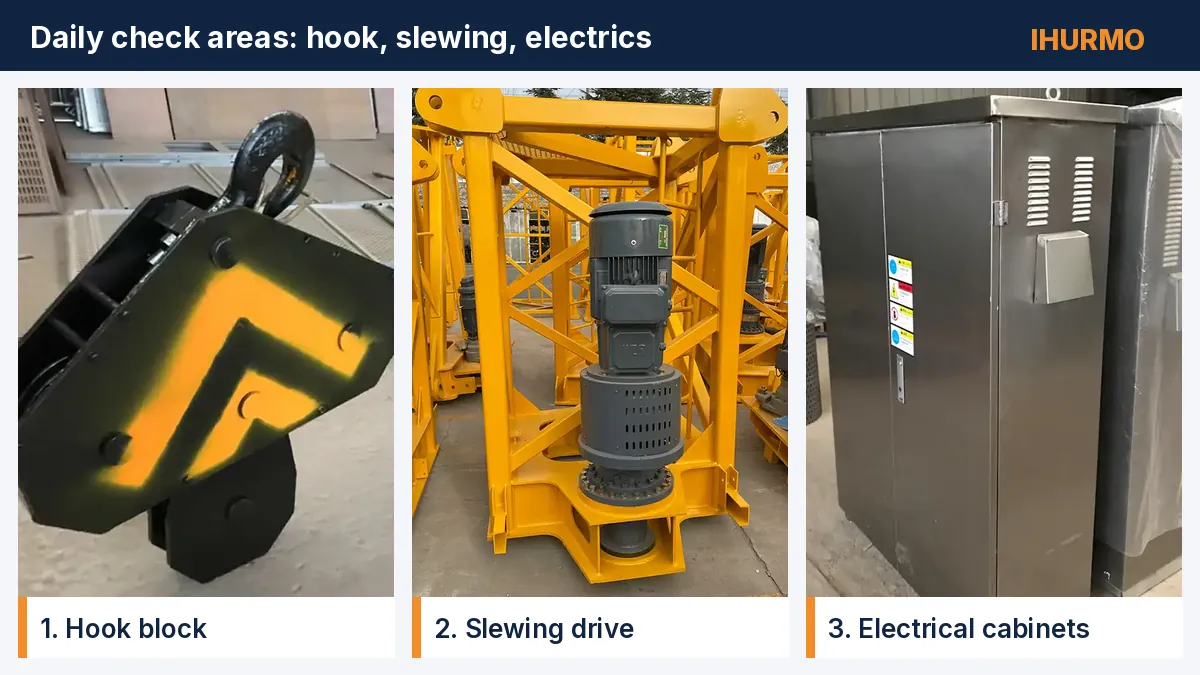
- The hook has a working safety latch that springs back. A missing or damaged latch takes the hook out of use.
- No cracks, no wear beyond the limit and no plastic deformation on the hook.
- Sheave guards are complete so the rope stays in the groove and cannot climb out.
- Sheaves turn freely without noise, and the bearings are greased on schedule.
6. Electrical System
- The main distribution box and the cab control cabinet are intact, rain-protected and lockable.
- Cables show no cuts, ageing or burn marks; terminals are tight with no heat or arcing.
- Emergency stops and master controllers respond reliably, and the crane starts and stops without jerks.
- Earthing and protective conductors are complete, earth resistance meets the applicable rules, and the residual current device trips when tested.
7. Climbing and Tie-In System
- Hydraulic climbing unit: no internal or external leaks from the cylinder, the hydraulic lock and balance valve work, and the hoses are not aged or damaged.
- Climbing work: only certified personnel carry out jacking. No climbing at night or in strong wind.
- Tie spacing: follow the approved project plan. The free-standing height above the last tie must never exceed the value in the regulations or the manual.
- Aviation lights: tall cranes are fitted with obstruction lights as required, and they stay on at night.
8. People and Site Conditions
- Crane operators, signal persons and riggers hold valid certificates, and the person on duty is the person on the certificate.
- Stop all lifting in winds of force 6 or above on the Beaufort scale (10.8 to 13.8 m/s), and in heavy rain, dense fog or thunderstorms. Your crane’s manual may set a lower limit; see our article on crane wind speed limits.
- No side pulling or dragging loads, no lifting buried or stuck objects, no lifting people, no overloads and no loads of unknown weight.
- Give the crew a safety briefing before work, set up an exclusion zone where work areas overlap, and keep unauthorised people out.
The Red Lines in One Table
| Red line | Why it matters |
| Adjusting, removing or shorting a limiter | The crane loses its only automatic protection against overload |
| Raising moment limiter settings | The crane is then rated above what it was designed for |
| Side pulling, buried loads, lifting people, overloading | Each one puts unplanned forces on the jib, mast and rope |
| Lifting loads of unknown weight | The operator cannot tell if the lift is within the load chart |
| Climbing at night or in strong wind | Climbing is when the crane is least stable |
None of these items needs special tools. What they need is a crew that treats a failed check as a decision already made, rather than something to negotiate with the schedule. If a site manager has to approve every stop, the checklist will slowly turn into paperwork.
Frequently Asked Questions
What is the difference between a load limiter and a load moment limiter?
The load limiter watches the weight on the hook. The load moment limiter watches weight multiplied by radius, so it stops the crane from carrying a load too far out along the jib even when the weight itself is within the maximum.
Who should do the daily checks?
The crane operator, together with the site’s responsible person for lifting equipment. Defects should be recorded and the crane kept out of service until a competent person has signed it off.
Can climbing be done in the evening if the site is lit?
The site chart we based this guide on says no climbing at night. Follow the manufacturer’s climbing procedure and your approved plan, which normally set daylight and wind conditions for climbing.
Are aviation obstruction lights always required?
It depends on crane height, location and local aviation rules. Tall cranes, and cranes near airports, generally need them. Check with the local authority during planning.
Work With IHURMO on Your Next Tower Crane
IHURMO tower cranes, including our 5 t QTZ63 TC5011 tower crane, are listed with overload protection, anti-collision technology and PLC controls, and are built to ISO 9001 with CE certification. Browse the tower crane range or contact us to discuss jib length, capacity and spare parts for your project.