A scissor lift is easy to treat like a ladder with a motor. It goes straight up, the controls are simple, and most jobs take minutes. That familiarity is the problem. Falls from the deck and tip-overs usually trace back to two things: a pre-use check that was skipped, or a safety device that someone disabled to save time.
This checklist is written for site managers, rental fleet owners and buyers who need a clear standard for what “ready to use” means. It covers the machine walk-around, the people on the deck, how to raise and lower, and the behaviours that should end a shift on the spot.
The 10-Point Machine Walk-Around
Do this before the first lift of every shift, with the platform fully lowered and the machine on level ground. Anything that fails goes on the defect report and the lift stays tagged out until it is repaired.
Platform and Guarding
- Guardrails and entry gate. Rails, mid-rails and toe boards should be complete, straight and pinned. Site checklists in China commonly set a minimum rail height of 1.2 m; whichever figure you work to, the rail height must match the manufacturer’s specification and your local regulation. The gate must close and latch on its own.
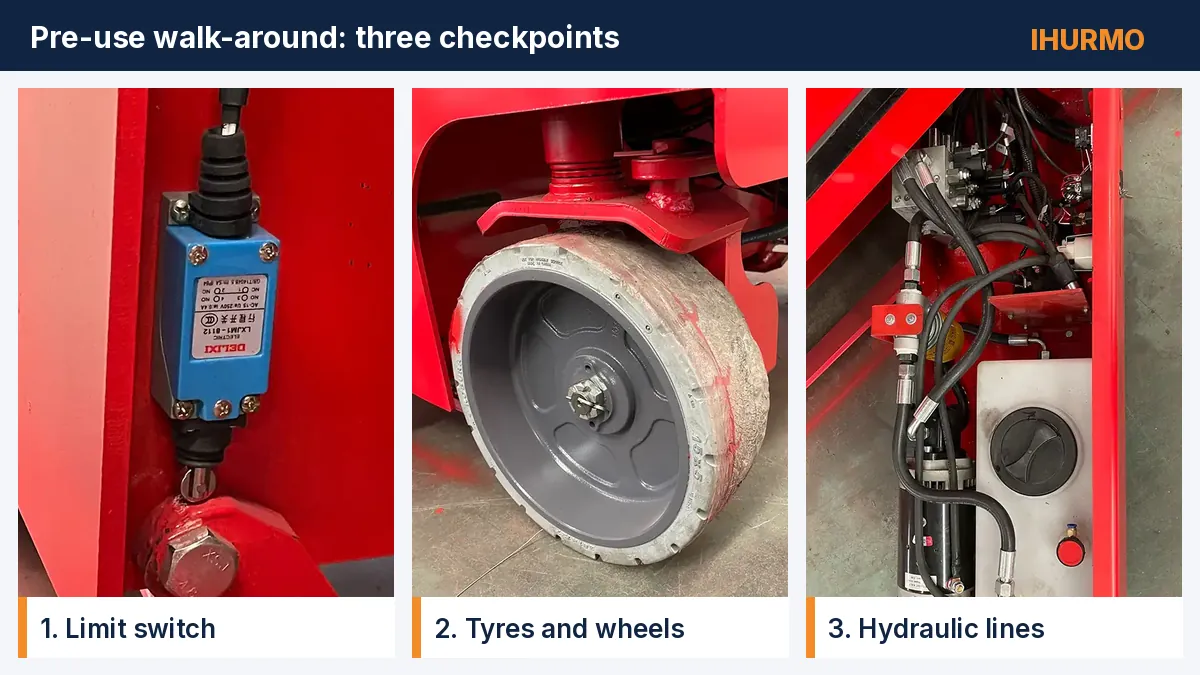
- Upper limit switch. Confirm the switch body is intact and the lever returns freely. Raise the platform to its upper limit and check that lifting stops there.
- Load test before work. At the start of the job, raise the platform with its intended working load and watch for creeping, unusual noise or slow response.
Hydraulics, Power and Chassis
- Lift cylinder. Look for oil on the cylinder rod, the hoses and the fittings underneath. Fresh oil on the chassis is a reason to stop and find the source.
- Battery. Check for electrolyte leakage, corrosion on terminals and loose cable lugs. A wet battery tray is not a cleaning job; it is a defect.
- Tyres and wheels. Look for cuts, chunks missing from solid tyres and damaged hubs. Uneven wear can point to a steering or alignment problem.
- Drive at height. With the platform slightly raised, check that drive and steering respond smoothly and without delay. Do this only in a clear, level area.
Emergency Functions
- Emergency stop buttons. Test the stop on the platform and on the ground control panel. Each one should cut all functions.
- Emergency lowering. Locate the manual lowering valve or pull cable and confirm it works. Everyone on the deck and one person on the ground should know where it is.
- Pothole protection. The pothole guards drop when the platform rises. Check that they deploy fully and that their limit switch stops the lift if they do not.
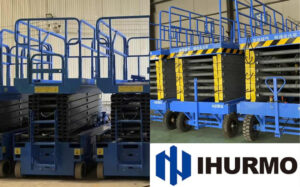
If your machines are from IHURMO, the listed safety equipment varies by model. Our 500 kg 8 m self-propelled electric scissor lift, for example, lists emergency stop buttons, overload sensors, guardrails with gates and a non-slip deck, while the SJY0.5-4 electric scissor lift lists overload protection, anti-drop devices and manual emergency lowering valves. Use the manual for your model to set the pass criteria.
Who Is Allowed on the Deck
Machine checks only cover half of the risk. The site checklist this article draws on lists four conditions for the people using the lift:
| Requirement | What to check |
| Qualified operator | The operator holds the training or licence your jurisdiction requires for mobile elevated work platforms. |
| No alcohol | Nobody operates or rides the lift after drinking. Supervisors should remove anyone who appears impaired. |
| Fall protection | Workers wear the harness and lanyard your site rules and the manufacturer specify, attached to the designated anchor point. |
| Controlled work zone | The area below and around the lift is barricaded and signed so that pedestrians and vehicles stay out. |
For a fuller treatment of training, fall protection and compliance, see our scissor lift safety guide.
Raising, Lowering and What to Do When Power Fails
- Close the gate first. Once everyone is on the deck, shut and latch the entry gate or chain, confirm the platform is stable, then start raising.
- Move the joystick smoothly. Repeated jabs at the controller cause hydraulic shock, which loads the cylinder, hoses and pins. Use steady, progressive inputs.
- If power or hydraulics fail at height, press the emergency stop. A trained person on the ground then lowers the platform with the manual release. The people on the deck stay inside the guardrails and wait; climbing or jumping off the platform is never the way out.
Five Rules That End the Shift
These are the actions that turn a routine job into an incident. Treat each one as a stop-work violation, not a reminder.
- No removing, blocking or modifying safety parts. That includes guardrails, pothole guards, the tilt sensor, the explosion-proof (hose-burst) valve and overload protection.
- No overloading. Stay within both the rated load and the rated number of people. Tools and materials count toward the load.
- No towing with people aboard. A lift carrying people must not pull or drag vehicles or other equipment.
- No stepping off at height. Workers must not climb or step from the platform onto a building, roof edge or scaffold.
- No working with a known fault. Strange noises, oil leaks or controls that do not respond mean park the machine, lower it and report it. Do not “finish the job first”.
Many of these faults show up earlier as small symptoms. Our article on common scissor lift problems covers how to diagnose them before they become a stop-work issue.
Using This Checklist When You Buy or Rent
A checklist is only as good as the machine’s ability to pass it. When you compare scissor lifts, ask the supplier which of the ten points are covered by standard equipment, how the pothole guard and tilt protection are interlocked, and where the manual lowering control sits. If you want to see how the lifting mechanism and safety systems fit together, read how a scissor lift works.
Frequently Asked Questions
How often should a scissor lift be inspected?
Run the walk-around and function test before every shift. Periodic and annual inspections by a qualified person are separate requirements; their intervals depend on your local regulations and the manufacturer’s manual.
Who should perform the pre-use inspection?
The trained operator who will use the lift that shift. Defects should be recorded and reported to the supervisor, and the lift should not be used until a competent person has repaired and released it.
What should operators do if the platform will not lower?
Press the emergency stop, stay inside the guardrails and call the ground person, who uses the manual emergency lowering control. Never climb down the scissor stack or step onto a nearby structure.
Can a scissor lift be driven with the platform raised?
Some self-propelled models are designed to drive with the platform raised, but only on firm, level ground and within the limits in the manual. Check that the pothole guards and tilt protection work before you do it.
Talk to IHURMO About Your Fleet
IHURMO supplies electric, self-propelled and mobile scissor lifts for construction and maintenance work. Tell us your working height, load and site conditions, and we will help you match the safety equipment to the job. Browse our scissor lift range or contact our team for a quotation.