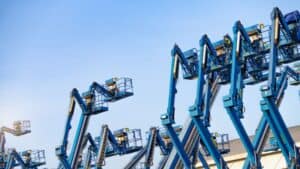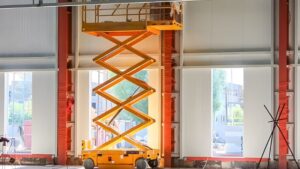
Overview of Boom Lift and Scissor Lift
Both scissor lifts and boom lifts provide elevated access for construction and maintenance work, but they accomplish this through different mechanisms designed for specific applications.
A boom lift uses an extendable arm that provides both vertical and horizontal reach, maneuvering up, over, and around obstacles. A scissor lift employs a vertical crisscross mechanism that offers a stable, spacious platform moving straight up and down.
What Is a Boom Lift?
A boom lift is an aerial lift that provides versatile positioning through its articulated or telescopic arm system. The platform sits at the end of a hydraulic arm that extends outward and upward, offering unparalleled reach capabilities.
Types of Boom Lifts
- Articulating boom lifts: Feature multiple joints allowing the boom to bend around obstacles, typically reaching 30 to 80+ feet with substantial horizontal extension
- Telescopic boom lifts: Single extendable arm reaching maximum height up to 185 feet, ideal for bridge maintenance and tall building construction
Advantages of Boom Lift
- Horizontal reach of 30 to 80+ feet from base position
- Articulating boom navigates around obstacles with up-and-over capability
- 360-degree rotation for versatile positioning
- Maximum heights exceeding 150 feet
Limitations of Boom Lift
- Larger footprint requiring more setup space
- Wind-sensitive, unsafe above 28-35 mph
What Is a Scissor Lift?
A scissor lift uses a crisscross support structure to rise vertically, providing exceptional stability while lifting workers and materials straight up to the work area.
Types of Scissor Lifts
- Electric scissor lifts: Battery-powered with zero emissions, designed for smooth indoor surfaces, reaching 19-40 feet
- Rough terrain (RT) scissor lifts: Diesel-powered with rugged tires for uneven outdoor surfaces, reaching 25-50 feet
Advantages of Scissor Lift
- Compact footprint and excellent maneuverability
- Superior stability with 1,000-2,500 lb (roughly 4–10 adults with gear) capacity
- Larger platform accommodating multiple workers
Limitations of Scissor Lift
- Vertical-only movement, no horizontal reach
- Height limitations of 40-50 feet maximum
- Requires frequent repositioning
- Cannot navigate around obstacles
Boom Lift vs Scissor Lift: Main Differences
|
Feature
|
Boom Lift
|
Scissor Lift
|
|---|---|---|
|
Movement Type
|
Vertical + Horizontal (Up, over, and around)
|
Vertical only (Straight up and down)
|
|
Max Vertical Reach
|
Exceptional (Up to 185 feet)
|
Limited (Typically 19 to 50 feet)
|
|
Horizontal Reach
|
Significant (30 to 80+ feet extension)
|
None (Requires moving the entire base)
|
|
Platform Size
|
Small/Compact (2-4 feet square)
|
Large/Spacious (6-8 feet long)
|
|
Weight Capacity
|
Lower (500–1,000 lbs; 2–4 people)
|
High (1,000–2,500 lbs; 4–10 people)
|
|
Maneuverability
|
High; navigates around obstacles
|
Limited; needs clear space directly below
|
|
Footprint/Space
|
Large; needs wide radius for arm & base
|
Compact; fits in narrow aisles/doorways
|
|
Terrain
|
Excellent; handles rough/uneven ground
|
Variable (RT models for outdoors only)
|
|
Best Environment
|
Building exteriors, bridges, utility work
|
Warehouses, indoor ceilings, HVAC work
|
|
Fall Protection
|
Harness and lanyard mandatory
|
Guardrails (Harness often optional)
|
Choosing the Right Lift for Your Project
Select between boom and scissor configurations by analyzing your specific project parameters for maximum productivity and cost control.
Applications and Use Cases
Choose a Boom Lift When:
- Horizontal reach beyond base position is essential
- Working on building facades, exteriors, or multi-story structures
- Projects involve obstacles requiring up-and-over access
- Heights exceed 50 feet
- Tree trimming, utility work, or telecommunications installation
Choose a Scissor Lift When:
- Work is directly overhead (ceilings, ductwork, lighting)
- Interior construction or warehouse operations
- Confined spaces require compact equipment
- Multiple workers need simultaneous platform access
- Budget constraints are a priority
Large construction projects often deploy both types strategically—scissor lifts for interior work while using boom lifts for exterior and hard-to-reach areas.
Safety Features and Fall Protection
Boom Lift Safety Requirements
Boom lifts require operators to wear full-body harnesses with lanyards attached to basket anchor points. Wind limitations significantly impact safety, with most manufacturers specifying maximum wind speeds of 28 to 35 mph. The extended boom creates stability concerns in gusty conditions, potentially causing weather-related delays.
Scissor Lift Safety Requirements
Scissor lifts typically rely on guardrail protection, though many site-specific rules still require personal fall arrest systems. The stable, wide-base design and vertical-only movement create inherently safer conditions. Lifts may operate in higher wind speeds than boom equipment, reducing project delays.
Both lift types require:
- Pre-operation inspections and regular maintenance
- OSHA-compliant operator certification
- Adherence to weight limits and manufacturer guidelines
The simpler operation and inherent stability make scissor lifts the safer choice for less experienced operators.
Frequently Asked Questions
Which is safer, a boom lift or scissor lift?
Both are equally safe when operated properly with appropriate training and certification. Scissor lifts have simpler controls and greater stability, making them easier for less experienced operators. Boom lifts require more extensive training but provide safe operation when used by qualified personnel following manufacturer guidelines.
Why are boom lifts so expensive?
Boom lifts cost more due to their complex hydraulic systems, advanced engineering, and extensive reach capabilities. The articulated or telescopic arm mechanisms require sophisticated components and regular maintenance. Additionally, their specialized applications and lower production volumes compared to scissor lifts contribute to higher rental and purchase prices.
Can these lifts be used on sloped ground?
Most standard lifts require a level surface to operate safely. However, many modern boom lifts feature “oscillating axles” and advanced self-leveling systems that allow them to traverse slopes. In contrast, scissor lifts are highly sensitive to tilt; if the base is not level, a tilt sensor will usually trigger a safety cutout, preventing the platform from rising until the machine is on flat ground.