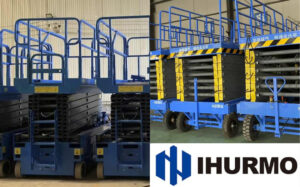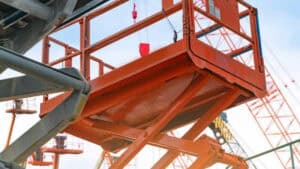
Choosing the right scissor lift is essential for safe, efficient work at height. Whether you need to navigate tight indoor spaces or tackle rugged outdoor terrain, understanding the different types, features, and uses helps you make the best decision for your project.
Main Types of Scissor Lifts
Electric Scissor Lifts
Electric scissor lifts use battery power, making them ideal for indoor applications. They operate quietly and emit no fumes, so they’re perfect for warehouses, retail stores, and other enclosed spaces. Their compact size allows for easy movement through narrow aisles and doorways, making them popular for maintenance, inventory, and installation tasks.
These lifts are best suited for smooth, level surfaces such as concrete floors. Most electric scissor lifts reach heights between 20 and 40 feet, and their platform capacity typically ranges from 500 to 1,000 pounds. The battery system requires regular charging, but the clean, quiet operation is a major advantage for indoor work.
Diesel Scissor Lifts
Diesel scissor lifts are designed for outdoor construction sites and rough terrain. Powered by diesel engines, they deliver more lifting capacity and can reach higher elevations, often up to 60 feet. These aerial lifts are best for heavy-duty tasks where power and durability are necessary.
Diesel models are larger and noisier, and they produce exhaust fumes, so they’re not suitable for indoor environments. Their robust construction and powerful engines allow them to handle uneven or unpaved surfaces, making them the go-to option for demanding outdoor jobs.
Hydraulic Scissor Lifts
Hydraulic scissor lifts use pressurized oil to raise and lower the work platform smoothly. Most electric, diesel, and rough terrain scissor lifts incorporate hydraulic systems, providing reliable and controlled movement. The simple controls make them easy for operators to use, and the hydraulic mechanism ensures precision during elevation.
However, cold weather can affect hydraulic oil viscosity, potentially slowing lift operation. Modern hydraulic scissor lifts address this with improved fluid systems, but it’s still important to consider temperature when planning outdoor work.
Pneumatic Scissor Lifts
Pneumatic scissor lifts use compressed air instead of fuel or electricity. This type of scissor lift is environmentally friendly, producing no emissions and requiring less maintenance. Pneumatic lifts are suitable for indoor use and sensitive environments where air quality is a concern.
Although they typically offer less lifting power and platform capacity than diesel or rough terrain models, pneumatic lifts are a sustainable choice for light-duty tasks and businesses aiming to reduce their carbon footprint.
Rough Terrain Scissor Lifts
Rough terrain scissor lifts are engineered for outdoor jobsites with uneven ground. Equipped with heavy-duty tires and powerful engines, these lifts maintain stability on dirt, gravel, grass, or other challenging surfaces.
Key Features for Outdoor Performance
Rough terrain scissor lifts feature large, rugged tires designed for traction and durability. Their platform capacity ranges from 500 to 1,500 pounds, allowing multiple workers and equipment to be lifted at once. Most rough terrain models use diesel engines for the power needed to climb slopes and navigate difficult terrain.
Some models include outriggers for added stability on slopes or soft ground. The substantial weight of these lifts helps anchor them securely, even on uneven surfaces. Platform sizes typically range from 4 to 8 feet, providing ample workspace for outdoor construction sites.
When to Choose Rough Terrain Models
Choose a rough terrain scissor lift for projects on unpaved surfaces, such as building construction, bridge work, or outdoor facility maintenance. Their four-wheel drive and large tires let operators move across muddy, sandy, or rocky areas where standard lifts can’t go. These lifts are also ideal for agriculture, landscaping, and outdoor events where ground conditions vary.
Sizes and Capacities of Scissor Lifts
Scissor lifts are available in various sizes, each offering different platform heights, working heights, and weight capacities. The right size depends on your project needs and work environment.
Small Scissor Lifts
Small scissor lifts provide platform heights from 12 to 20 feet and working heights up to 26 feet. They are compact (about 30 to 32 inches wide), making them perfect for indoor use in warehouses or tight spaces. Platform capacity for small lifts usually ranges from 350 to 800 pounds, with some models supporting up to 1,200 pounds.
Medium Scissor Lifts
Medium scissor lifts reach platform heights of 26 to 40 feet and working heights up to 46 feet. These lifts are wider (32 to 69 inches) and can weigh between 4,000 and 9,000 pounds. Electric models typically support 500 to 1,000 pounds, while rough terrain diesel lifts can handle up to 1,500 pounds. The larger platform size allows for more tools and materials, making them versatile for both indoor and outdoor tasks.
Large Scissor Lifts
Large scissor lifts offer platform heights above 40 feet, with some models reaching up to 53 feet and working heights near 60 feet. These heavy-duty lifts are wide (69 to 92 inches) and can weigh over 14,000 pounds. Their weight capacity peaks at 2,500 pounds, making them suitable for multiple workers and heavy equipment on outdoor construction sites or large-scale projects.
Specialized Scissor Lift Designs
Mobile Scissor Lifts
Mobile scissor lifts are aerial work platforms designed for easy movement between locations. Equipped with wheels or casters, they’re ideal for indoor work in warehouses or retail spaces where frequent repositioning is needed. Non-marking tires protect floors, while guardrails keep operators safe at height.
Self-Propelled Scissor Lifts
Self-propelled scissor lifts allow operators to move the lift while elevated, improving efficiency for tasks that require frequent repositioning. These aerial lifts are commonly powered by electricity or batteries for indoor use, and feature tilt sensors and automatic speed reduction for safety on uneven surfaces. Emergency stop buttons and descent systems are included for operator protection.
Fixed and Stationary Scissor Lifts
Fixed scissor lifts are permanently installed for repetitive lifting tasks, such as moving materials between floors in manufacturing plants or warehouses. These lifts often have higher weight capacities and are powered by hydraulic or electric systems connected to the building’s infrastructure, offering reliable performance with minimal maintenance.
Essential Safety and Performance Features
Modern scissor lifts include guardrails, emergency stops, tilt sensors, and overload alarms to protect operators. OSHA requires proper training, inspections, and checking platform capacity, tire condition, and stability before use—especially on uneven terrain.
Lifting Mechanism Overview
Scissor lifts use a crisscross “X” mechanism powered by hydraulic, pneumatic, or electric systems for stable vertical lifting. Hydraulic models handle 1,000–1,500 lbs and are reliable for various jobs. Electric versions are quiet and emission-free for indoor use, while diesel or dual-fuel lifts handle heavy loads and rough outdoor conditions. Regular maintenance, such as checking fluid levels and scissor arms, ensures safe operation.
Control and Emergency Systems
Controls on the platform and ground let operators raise, lower, or move precisely. Clearly marked emergency stops instantly halt motion, while backup systems allow safe lowering during power loss. Overload sensors and alarms prevent unsafe operation, helping meet OSHA safety standards.
Stability and Operator Protection
Guardrails and toeboards prevent falls and dropped tools, while self-closing gates secure entry points. Outriggers widen the base on rough terrain, and tilt sensors lock controls if the platform becomes unstable—ensuring stability on both indoor floors and outdoor sites.
Why Choose IHURMO
At Ihurmo, we deliver world-class lifting and construction solutions—from advanced scissor lifts to tower cranes and hoists—trusted in over 100 countries. Certified by ISO, CE, and EAC, our products ensure safety, reliability, and performance on every jobsite. Let IHURMO help you elevate your work to new heights—contact us to find the perfect equipment for your project.
Frequently Asked Questions
How do boom lifts differ from scissor lifts?
Boom lifts feature extendable articulated or telescopic arms for reaching 30-210 feet horizontally, over obstacles, or with 360° basket rotation, ideal for irregular access like tree work or building facades. Scissor lifts, by contrast, provide straight vertical rise to a max of 50-60 feet on a wide, stable platform for flat, open areas like mezzanines or scaffolding. Booms offer flexibility but less capacity; scissors prioritize stability for multiple workers.
What is SWL on a scissor lift?
SWL stands for Safe Working Load, the maximum weight (including operators, tools, and materials) the platform can safely hold without overload alarms triggering. Small indoor models rate 200-500 kg (440-1,100 lbs), while heavy-duty rough terrain versions exceed 1,000 kg (2,200 lbs)—always check the yellow capacity plate on the chassis. Exceeding SWL risks structural failure, so factor in all loads before use.