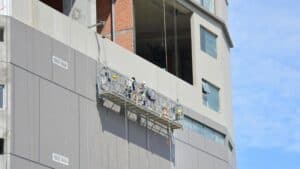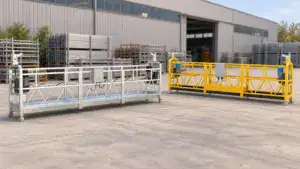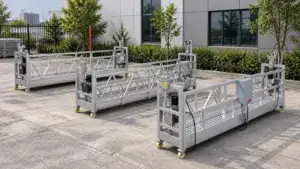
An electric suspended platform hangs on two wire ropes and a set of counterweights. If one of those elements fails, the cradle can tilt, drop or overrun the roof. That is why the daily check matters more than on most site equipment, and why it should be done the same way every time, by people who know what a pass looks like.
This 10-point checklist is written for site supervisors, safety officers and rental companies working with electric suspended platforms (also called gondolas, cradles or swing stages). It assumes the platform has already been installed and accepted. Use it before the first descent of each shift.
Hoist and Safety Devices
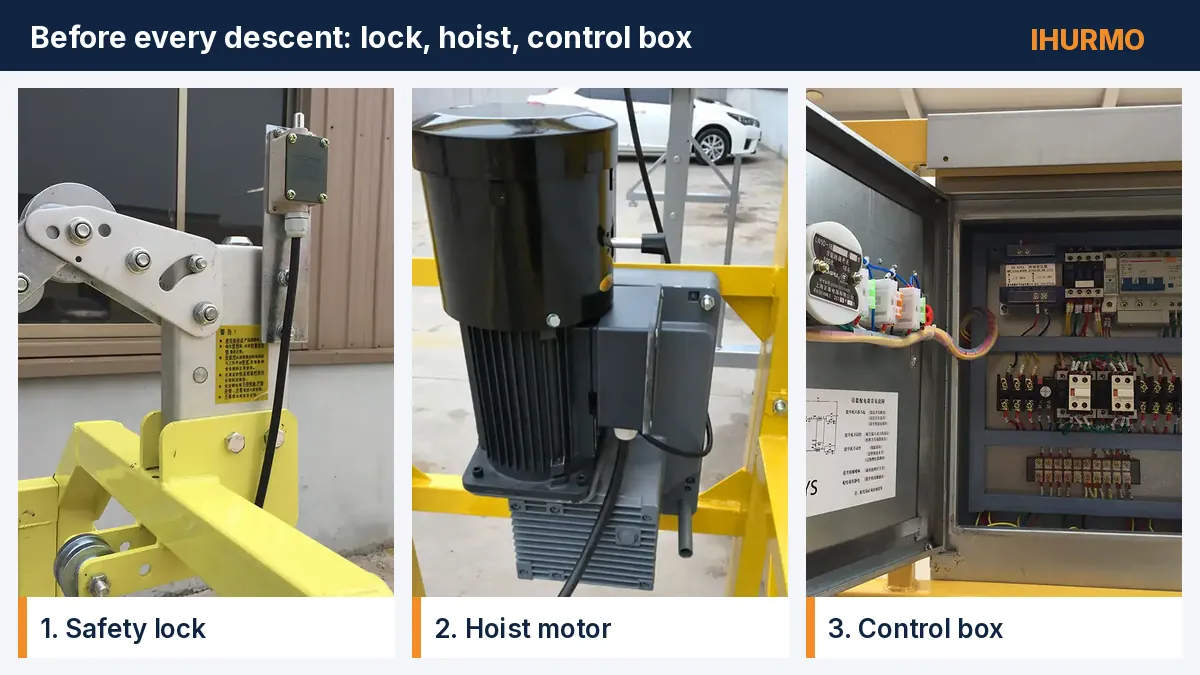
1. Safety Lock
- Push the swing arm by hand. It should spring back on its own when released, and the moving parts should be lubricated.
- Raise the cradle about 1 m, then run one end only so the cradle tilts. The safety lock should grip the safety rope and stop the tilt.
- The working rope runs inside the guide pulley; the safety rope passes through the centre of the safety lock. Never reverse them.
- The lock’s certificate should be within its calibration period, typically one year.
- Adjust or replace any lock that fails. Do not use the platform until it passes.
On IHURMO steel platforms such as the ZLP630, the safety lock is listed with an allowable impulsive force of 30 kN and a rope locking angle of 3° to 8°.
2. Upper Limit Switch
- Trip the switch by hand. The up circuit should cut out immediately and recover when released.
- The switch must make full contact with the limit plate. It must never be tied with wire.
- The housing should be undamaged and dry, and the micro-switch should respond sharply. Replace a failed switch straight away.
Cradle and Electrics
3. Cradle Bolts
- Check the bolts joining the floor sections and side rails, and tighten anything loose.
- No bolts missing, rusted or stripped. If two or more bolts are missing, do not use the cradle.
- Every bolt should have a flat washer and spring washer. A spring washer pressed completely flat suggests the bolt has loosened; re-tighten it.
4. Electrical Control Box
- Close the emergency stop, then press up and down. The contactors should switch cleanly, with no buzzing or arcing.
- Cables should have no burn marks or damage. Press the test button on the residual current device; it should trip.
- Terminals should be tight. The door should lock or be tied shut, and the box should be protected from rain.
Roof Rigging
5. Counterweights
- Use the counterweights specified in the installation plan. Bricks and sandbags are not counterweights.
- Press down on the tail of the counterweight frame. It should not lift. The through-bolts should be tight and the weights should sit fully on the support bar.
- Secure the top of the counterweight stack with wire rope and clips so the weights cannot be moved.
For reference, IHURMO’s ZLP630 and ZLP500 steel platforms are listed with an 800 kg counterweight.
6. Wire Rope and Rope Clips
- Use at least four rope clips at each termination.
- Fit the U-bolt on the short (dead) end of the rope, all facing the same way.
- Leave a small arc in the rope beyond the last clip. If that arc straightens, the clips ahead have slipped.
7. Rope Tensioner
- Typical faults are too few clips and no thimble where the rope meets the hook.
- Pull the rope by hand. It should not slip.
- Check the wedge and cam for wear and missing teeth, and check that the spring and bolts hold enough pre-load to keep the rope in place.
8. Safety Line (Lifeline)
- Anchor each worker’s lifeline independently to a reliable part of the building. Never tie it to the suspension mechanism or the counterweights.
- Look for cuts, burns and heavy fraying. Discard the line if damage reaches one third of its diameter.
- Slide the rope grab along the line, then give it a quick downward pull. It should lock instantly.
9. Limit Plate (Stop Plate)
- Fix the limit plate at the top of the safety rope, not the working rope.
- The plate should be flat and square to the limit switch roller. Adjust it if it has shifted by more than 2 cm.
- Do not tie it on with wire or cord. A plate that slips is how cradles overrun the roof.
10. Suspension Mechanism (Outriggers)
- Keep the front and rear frames level, with the legs fully extended and seated on timber or steel plates. No leg should be left hanging.
- The front beam overhang and rear length must match the plan. Adjustment bolts should be tight and pins secured with split pins.
- The frame should not rock, no pins should be missing and no welds should show visible cracks.
On the ZLP630 and ZLP500, the suspension mechanism is listed with a front beam overhang of 1.3 to 1.5 m and an adjustable height of 1.44 to 2.14 m. Compare models in our ZLP630 vs ZLP800 vs ZLP1000 guide.
Quick Reference Table
| Point | Fail condition |
| Safety lock | Does not lock when the cradle tilts, or calibration expired |
| Upper limit switch | Does not cut the up circuit, or tied with wire |
| Cradle bolts | Two or more bolts missing |
| Control box | RCD does not trip, burnt cables, arcing |
| Counterweights | Bricks or sandbags used, frame tail lifts |
| Rope clips | Fewer than four clips, U-bolts reversed |
| Rope tensioner | Rope slips when pulled |
| Lifeline | Tied to suspension or counterweight, or damage over 1/3 of diameter |
| Limit plate | On the working rope, offset over 2 cm, tied with wire |
| Outriggers | Legs not fully seated, pins missing, cracked welds |
Every point has to pass before anyone boards. For the wider picture, including fall protection, load management and rescue planning, see our safety guidelines for workers on suspended platforms. If you work in the US, our summary of OSHA suspended scaffolding requirements explains the federal rules.
Frequently Asked Questions
How do you test a suspended platform safety lock on site?
Raise the cradle about 1 m and run one hoist only so the cradle tilts. The safety lock on the low side should grip the safety rope and stop the tilt. If it does not, take the platform out of service.
Can the limit plate be fitted on the working rope?
No. Fit it at the top of the safety rope. The limit switch then stops the cradle before it reaches the suspension mechanism.
When should a lifeline be replaced?
Replace it when it is cut, burnt or heavily frayed, and in any case when damage reaches one third of the rope diameter. Replace it after it has arrested a fall.
Why are bricks and sandbags not allowed as counterweights?
Their weight is unknown, they break or soak up water, and they are easy to remove. The installation plan relies on the rated counterweights supplied with the platform.
Choose an IHURMO Suspended Platform
IHURMO supplies steel, aluminium alloy and hot-dip galvanised suspended platforms from ZLP500 to ZLP1000, with voltage options of 220, 380, 415 or 440 V on models such as the ZLP630. Browse the suspended platform range or contact our team with your building height and facade details for a quotation.