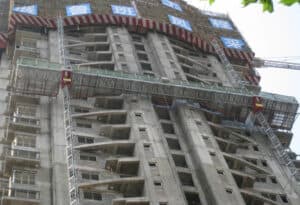
The facade layout should determine whether a project needs a single-mast or twin-mast system. A mast climbing work platform with one mast can suit a compact work area, while a twin-mast arrangement can cover a longer continuous work face. Each configuration places different demands on bases, ties, controls and load distribution.
For a useful single-mast vs twin-mast climbers comparison, start with the same facade drawing and material plan. Comparing maximum catalog figures without matching the configuration can produce a misleading result. Platform length, extensions and load positions must be assessed together.
How Single- and Twin-Mast Climbing Work Platforms Differ
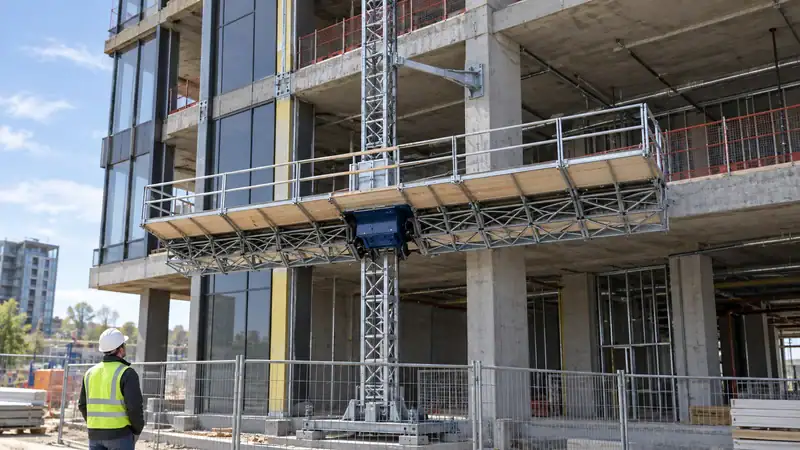
A mast climbing work platform travels vertically on one or more masts. Workers and materials remain on the platform as it moves to the required working level. This makes platform layout central to both access and productivity.
A single-mast platform is supported around one mast position. A twin-mast platform uses two mast positions with a platform arrangement spanning between them and any permitted end sections. The two drive units must operate within the manufacturer’s control and leveling requirements.
| Decision point | Single-mast arrangement | Twin-mast arrangement |
| Work face | Often useful for shorter or separated bays | Often useful for longer continuous elevations |
| Support layout | One mast and its specified base and ties | Two mast positions with coordinated supports and ties |
| Load review | Check permitted loading around the mast | Check loading between and beyond the masts |
| Relocation | Assess one mast setup at each position | Assess the complete two-mast setup and platform |
These are planning distinctions, not guaranteed limits. The manufacturer’s load diagrams establish the permitted arrangement for each model.
Match the Mast Climber Configuration to the Facade
Mark the areas that must be reached at each construction stage. Include corners, balconies, projections, recessed openings and changes in building height. A long elevation does not always require one long platform if the work is divided into separate zones.
For example, window installation may progress bay by bay, while cladding installation may benefit from several workers sharing a continuous work face. The material delivery method also affects the layout. A platform needs usable space for work, access and the planned supply of components.
Separate the required working length from the building’s total width. Parts of an elevation may be inaccessible from one position or scheduled for a later phase. Defining the actual work zone helps avoid paying for unnecessary platform sections.
IHURMO’s mast climber overview introduces its model families. For project selection, request the configuration drawing that corresponds to the proposed working area.
Compare Mast Climber Load Distribution
Prepare a list of workers, tools, equipment and materials present at the busiest stage. Then mark where each load will be placed. Total weight alone is not enough to compare mast climbers.
A pallet or material stack creates a different load pattern from the same mass spread along the platform. Loading near an end, on an extension or between two masts can change the permitted capacity. The relevant diagram must cover that arrangement.
Twin-mast capacity should never be estimated by simply doubling a single-mast rating. The assembled platform has its own structural and operating limits. Likewise, the maximum load and maximum length printed in a brochure may describe different configurations.
Ask the supplier to return the proposed layout with load zones identified. That drawing should show the selected length, mast spacing and permitted extensions. It gives procurement and site teams a common reference when reviewing competing offers.
Plan Mast Climber Bases and Building Ties
A workable platform arrangement requires suitable support positions at ground level and suitable connections to the building. Access routes, excavations, underground structures and ongoing ground works may constrain the location of a mast.
For twin-mast equipment, check both positions. One base may sit in a clear area while the other conflicts with a loading route or unfinished structure. Moving only one mast can change the platform arrangement and require another design review.
Tie positions also need coordination with the facade sequence. Openings, temporary works and finished cladding may limit where connections can be made. The supplier’s requirements and the building engineer’s assessment should be reconciled before the order is finalized.
Do not use a generic free-standing height or tie spacing as a purchasing shortcut. Those limits depend on the machine, configuration and site conditions.
Twin-Mast Platform vs Separate Single-Mast Work Zones
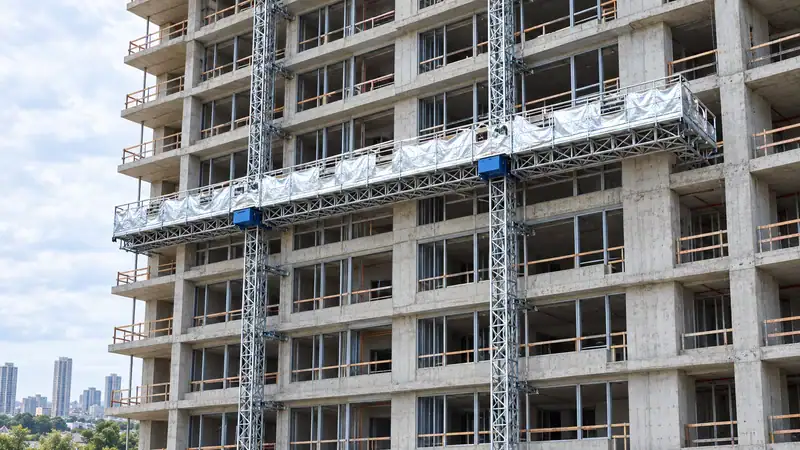
A continuous twin-mast platform can simplify movement along a broad elevation. It may allow the crew to work across a shared area without transferring between separate platforms. That benefit is strongest when the work sequence and material delivery support continuous access.
Separate single-mast setups may be worth reviewing when elevations have distinct work zones, different schedules or obstructions between bays. However, additional setups also affect access management, relocation and equipment quantities. Their apparent flexibility does not automatically make them cheaper.
Consider an illustrative facade with two separated work areas and different completion dates. A supplier could assess separate single-mast positions and a twin-mast alternative. Compare how each arrangement handles the obstruction, material supply and later relocation. The preferred option follows the project constraints, rather than the number of masts alone.
Compare Complete Mast Climbing Work Platform Quotations
Request the same scope from each supplier. Include the platform modules, masts, drive equipment, specified bases, ties, controls and approved accessories. Record which items belong to the equipment package and which are provided locally.
Assess the electrical supply and cable arrangement for the complete setup. For twin-mast systems, confirm the specified controls, leveling functions and response to a drive or power problem. The operating documentation should describe those functions clearly.
Plan for maintenance access and replacement parts. Identify which components must remain available during the project, how faults will be diagnosed and who provides technical support. A quotation that lists only the platform and masts leaves important responsibilities unresolved.
Include dismantling and relocation in the comparison. The cheapest initial arrangement may require more moves as the facade progresses, adding labor and time.
Request an IHURMO Mast Climbing Work Platform Configuration
Send IHURMO a facade elevation, site plan, working height and material loading schedule. Include obstructions, proposed base positions and the construction sequence. Ask for suitable mast climbing work platform options with configuration drawings and supply details. Contact IHURMO to compare single-mast and twin-mast arrangements against the same project requirements.
Mast Climbing Work Platform FAQs
Does a twin mast always carry more material?
It may offer more capacity in a suitable configuration, but the approved load diagram decides. Platform length, mast spacing, extensions and load positions can change the allowable load.
Can a single mast be converted into a twin arrangement?
Only where the manufacturer provides an approved conversion using compatible equipment. Shared model names or similar modules do not establish an authorized combination.