Construction hoist cable management must keep the moving cable supported, guided and clear throughout the cage’s travel. Selecting the arrangement involves more than choosing a cable length. Travel height, operating speed, cable construction, wind exposure and the available route all affect the specification.
For procurement teams, the priority is a matched system. The cable, supports, guides and any trolley should be reviewed together. Buying these items separately without a compatibility check can leave mechanical and electrical problems unresolved until installation.
How Construction Hoist Cable Management Works
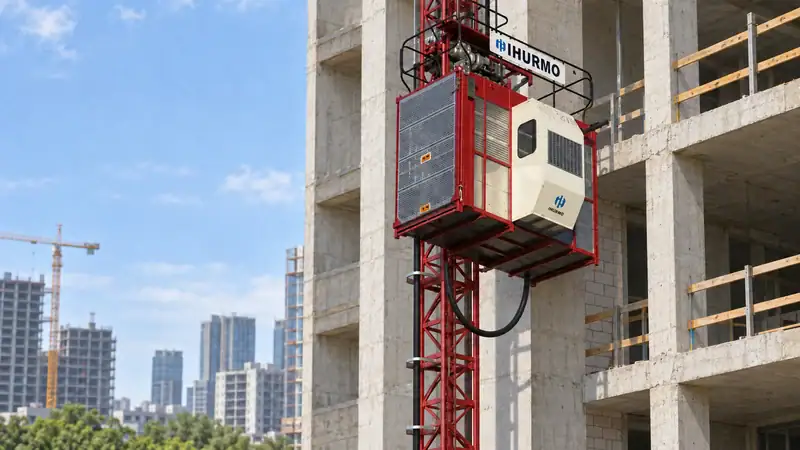
The incoming site supply delivers power to the hoist installation. The moving cable arrangement then accommodates cage travel. Cable management controls that movement so the cable does not rely on uncontrolled hanging, dragging or bending.
A guide frame helps keep the cable on its intended route. A collection basket or similar device manages stored cable at the base in configurations designed for that method. A cable arm positions the moving connection at the cage. A trolley arrangement uses a moving support and its specified guide path to manage the cable loop.
Terminology varies between suppliers. Request an arrangement drawing with every component labeled. It is easier to compare drawings than quotations that use different names for similar assemblies.
IHURMO’s construction hoist components guide introduces cable guides, pulley systems and cable arms. The procurement task is to establish which complete arrangement suits the proposed machine and site.
Compare Cable Collection and Cable Trolley Systems
| Arrangement | Main feature | Purchasing check |
| Cable collection with guides | Stores and guides cable through cage travel | Approved height, speed, cable type and collection space |
| Cable trolley system | Uses a moving support to manage the cable loop | Trolley path, cable support details and compatibility |
| Project-specific guiding arrangement | Addresses unusual layout or exposure conditions | Manufacturer’s drawing, limits and complete parts list |
These categories are not interchangeable packages. A supplier may use different arrangements across its hoist range. An apparently simpler system can be suitable within its approved conditions, while a trolley may be necessary for another application.
There is no reliable universal height at which every construction hoist must change to a cable trolley. The threshold depends on the machine, cable and approved design. Ask for the basis of the proposed arrangement instead of relying on a general height rule.
Specify Hoist Travel Height and Operating Conditions
Give the supplier the final travel height and each planned stage of mast extension. Include cage speed, expected duty and any changes between construction phases. A system sized for the first stage may need additional components before the hoist reaches its final height.
Provide a site elevation showing the cable route, cage position, mast ties and nearby structures. Note scaffold members, temporary platforms and other possible interference points. For twin-cage installations, identify each cage and its cable path separately.
Exposure also matters. Wind can influence cable movement, while dust, water and building debris affect guides and collection areas. Describe the actual environment rather than specifying only that the machine will operate outdoors.
As an example, two projects with the same lifting height can require different reviews. One may have a clear, sheltered cable route. The other may pass exposed facade zones and several temporary platforms. Height alone would conceal those differences.
Match the Trailing Cable to Mechanical Supports
The cable has electrical requirements and mechanical limits. Its mass, allowable tension, flexibility and minimum bending radius influence how it can be supported and guided.
The selected trolley, pulleys and supports must suit the specified cable. A larger cable is not automatically an improvement: additional weight and different bending behavior may change the mechanical requirements. Substituting a cable after the arrangement has been designed should trigger another compatibility review.
Ask the supplier to identify the cable specification, approved supports and attachment points. The proposal should also show how the route remains clear during cage movement and how maintenance personnel can inspect the components.
For a trolley system, confirm the supplied guide components, moving assembly and cable support hardware. A quotation containing only the trolley may omit parts required for the complete travel arrangement.
Check Electrical Requirements for the Moving Cable
A mechanically suitable cable route does not establish adequate electrical performance. The electrical design must consider the supply, cable length, conductor size and motor operating conditions.
Record the site voltage, phase and frequency, together with the location of the supply point. Distinguish the fixed supply run from the moving cable supplied with the hoist. Their responsibilities may sit with different contractors, but the complete route still needs coordination.
A trolley can change how cable is supported and routed. It does not, by itself, prove that voltage drop or motor starting requirements are acceptable. Those checks require the electrical details of the actual installation.
Request confirmation of who designs and supplies each cable section, protective device and connection. This prevents an equipment supplier and a site electrician from each assuming that the other has covered the same interface.
Compare Construction Hoist Cable Management Quotations
Ask suppliers to price the same height, operating conditions and scope. A useful schedule records:
- Hoist model, cage arrangement and operating speed.
- Initial and final travel heights, including extension stages.
- Fixed supply details and moving cable specification.
- Guide frames, collection equipment, trolley and support hardware.
- Drawings, installation instructions and inspection information.
- Spare parts, packing details and responsibilities for site connections.
Require a list of components needed for each extension stage. This can reveal whether the initial offer includes the final installation or only the first phase.
Compare maintenance access as well as price. A system with poorly accessible wear points may increase inspection effort or make a minor replacement more disruptive. Ask how guides, rollers and cable connections are identified in the parts documentation.
Plan Cable Inspection and Replacement before Delivery
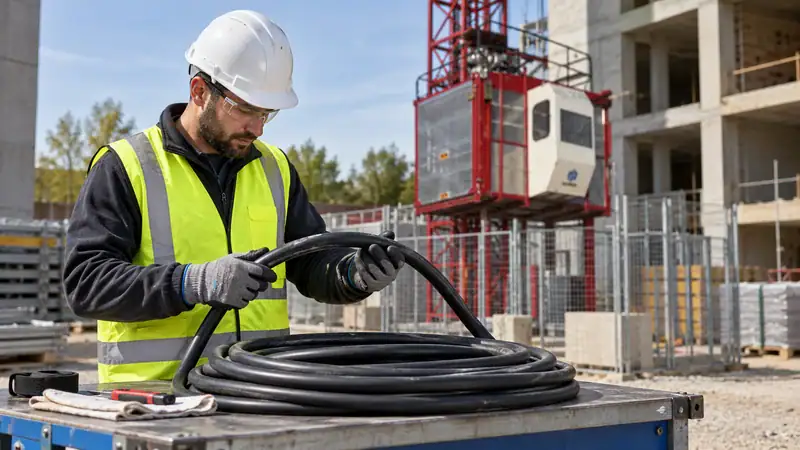
Include the manufacturer’s inspection requirements in the handover package. The site team needs to recognize abrasion, damaged guides, abnormal cable movement and loose or worn components. Defects require assessment under the approved maintenance process.
Record cable and component identification details when the equipment arrives. Replacement orders should reference the machine, cable specification and assembly revision. Matching only the cable diameter or appearance is insufficient.
Keep the route and collection area clear under the site’s housekeeping plan. The arrangement should also be checked after changes that could affect clearance, such as mast extension or adjacent scaffold work. Inspection does not replace the original design review; both serve different purposes.
Review Construction Hoist Cable Management with IHURMO
Send IHURMO the construction hoist model or required capacity, final travel height, cage speed and site power details. Add an elevation showing the proposed cable route and extension stages. Contact IHURMO to discuss a matched cable management arrangement and request an itemized quotation covering guides, supports, cable and any required trolley equipment.
Construction Hoist Cable Management FAQs
Does every tall hoist need the same trolley?
No. Trolley selection depends on the approved hoist and cable arrangement. Similar lifting heights do not establish compatible trolley systems.
Can a replacement cable use a different specification?
Only after the manufacturer confirms compatibility with both the electrical system and mechanical cable management arrangement. Changes in weight or flexibility can matter even when the conductor rating appears suitable.