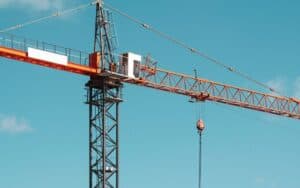
This article provides an in-depth comparison between jib cranes and davit cranes.
We’ll explore their definitions, common types, design differences, applications, and features, ensuring that you have all the information you need to make an informed decision.
Key Takeaways:
- Both jib and davit cranes serve unique roles in lifting operations.
- Jib cranes generally offer greater lifting capacity, while davit cranes provide portability in tight spaces.
What Is a Davit Crane?
A davit crane is a specialized type of crane that consists of a beam or arm mounted at an angle on a vertical support post.
This design allows it to lift and lower loads with great efficiency.
Davit cranes are often equipped with a hoist or winch to facilitate lifting operations. They come in various configurations, such as wall-mounted and portable versions, providing flexibility in usage.
What Is a Jib Crane?
A jib crane features a horizontal arm, known as a jib, which is fixed at one end to a vertical post or wall.
The jib extends outwards, allowing for rotational movement. This makes jib cranes ideal for lifting and moving loads to specific locations.
Like davit cranes, they can also be equipped with hoists, and many models have the option of telescopic arms, enhancing their reach.
Common Types of Jib Cranes
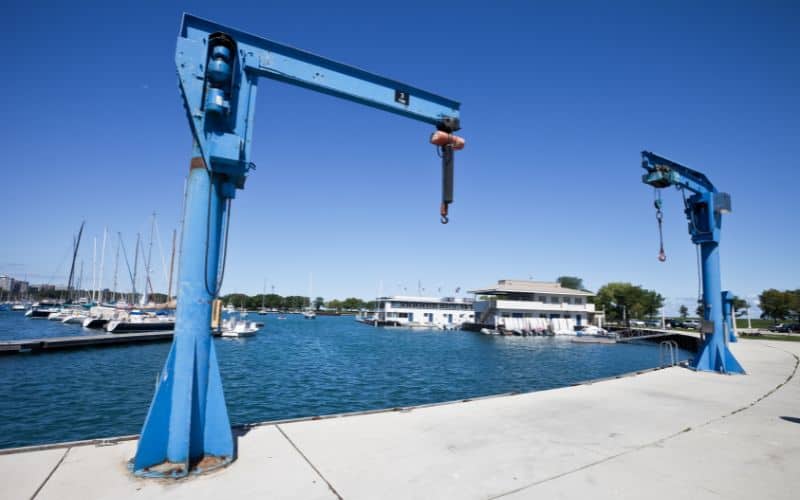
Jib cranes are available in various configurations to suit different applications:
- Wall-Mounted Jib Cranes: Attached directly to the structure, wall-mounted jib cranes save floor space and are ideal for light to moderate lifting tasks.
- Freestanding Jib Cranes: These systems stand independently and are suitable for heavier loads, often found in manufacturing facilities.
- Articulating Jib Cranes: Equipped with a flexible arm, articulating jib cranes can reach around obstacles and provide enhanced maneuverability.
- Mast Jib Cranes: Combining the features of a jib crane and a mast tower, these cranes offer excellent height and reach flexibility.
Is a Tower Crane Classified as a Jib Crane
Most tower cranes fall under the category of jib cranes because they use a jib for lifting, but not all jib cranes are tower cranes.
Tower cranes are defined by their “tower structure”, not by their boom type. Most tower cranes do have a jib , so they can be a subset of jib cranes in terms of boom function.
However, not all jib cranes are tower cranes, for example, a small “pillar jib crane” in a factory has a jib but no tower.
Rarely, some special tower cranes may use non-jib structures, so they are not jib cranes.
For detailed information and product inquiries, visit ihurmo.com, professional tower crane manufacture.
Comparing Jib Cranes, Hoists, and Davit Arms
As mentioned, these cranes have a horizontal arm and are versatile for job sites with open space. They support various hoists and can lift heavier weights, making them suitable for multiple industrial applications.
While hoists are used for raising and lowering materials, they can be integrated with both jib and davit cranes to enhance lifting capability. An electric or manual hoist mounted on a jib crane can greatly increase efficiency.
Davit Arms are specific components of davit cranes and focus on lifting loads in restricted environments. They are well-suited for use on ships, allowing for quick deployment.
Application Comparison
- Jib Crane Applications: Commonly found in manufacturing, warehouses, and construction sites. Their ability to move loads horizontally makes them ideal for assembly lines, loading docks, and areas requiring frequent handling of materials.
- Davit Crane Applications: Primarily used in marine applications, including shipbuilding and repair. Their design allows precise handling of loads in tight spaces, making them invaluable for tasks like lifting small boats or equipment on and off vessels.
Feature Comparison
When comparing the features of jib and davit cranes, consider the following:
- Portability: Davit cranes are often more portable than jib cranes, especially in configurations meant for marine environments.
- Height and Reach: Jib cranes often have greater height and reach options due to their horizontal design and telescopic features.
- Weight Capacity: Depending on the specific model and design, jib cranes generally have the advantage in weight capacity, particularly in industrial settings.
Jib Cranes vs. Davit Cranes: Compare Chart

| Feature | Davit Crane | Jib Crane |
| Structure | Angled arm on vertical support | Horizontal arm extending from vertical post |
| Usage Locations | Limited space, often wall-mounted or portable | Versatile application in various settings |
| Rotational Range | Limited (typically 180 degrees) | Broad range (up to 360 degrees on some models) |
| Load Capacity | Generally lower load capacities | Higher load capacities possible |
| Mobility | Often portable for marine applications | Can be fixed or mobile based on design |
Introducing IHURMO’s Lifting Solutions
At IHURMO, we offer a wide range of lifting solutions to suit your specific needs. Our products are engineered for durability, efficiency, and safety, making them ideal for all lifting applications. Explore our offerings at ihurmo.com to find the perfect crane for your operations.
FAQs
What is the primary difference between jib cranes and davit cranes?
Jib cranes feature a horizontal arm extending from a vertical post, allowing for rotational movement and broad lifting capabilities. In contrast, davit cranes have an angled arm mounted on a vertical support and are typically used in confined spaces, making them well-suited for marine applications.
What types of jib cranes are available?
The most common types of jib cranes include: wall-mounted jib cranes, freestanding jib cranes, articulating jib cranes and mast jib cranes.
Can jib cranes handle heavy loads better than davit cranes?
Generally, yes. However, the load capacity can vary significantly based on the specific model and design.
Are there portable options for both jib and davit cranes?
Yes, both crane types can be found in portable configurations.
How do hoists integrate with jib and davit cranes?
They are integrated by attaching an electric or manual hoist.
In what applications are jib cranes commonly used?
Manufacturing, warehouses, and construction sites.
What are the key features to compare when selecting between jib and davit cranes?
Portability, height and reach and weight capacity.
How does IHURMO support crane operators and businesses?
IHURMO provides a wide range of construction equipment and lifting solutions, including both jib and davit cranes. Our products are designed for durability and efficiency, backed by exceptional customer service and support. For more information, visit ihurmo.com.