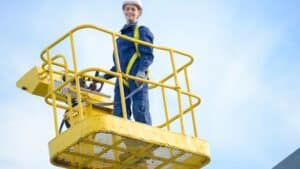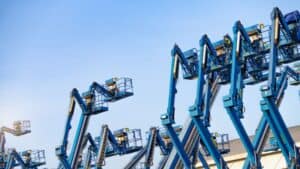
The lifting equipment industry, like any other modern industry, has a long list of acronyms and abbreviations, the acronym MEWP is one of them. You may see it on a job site or in a safety manual and wonder what it means. In fact, MEWP stands for Mobile Elevating Work Platform. This term refers to mobile aerial work platforms that lift individuals, tools, and materials to elevated work positions.
MEWPs are used across various industries for tasks requiring temporary access at height. It’s a crucial term in industries like construction and maintenance where working at height is part of the daily routine. Understanding the concept of MEWP is key to both safety and communication.
Understanding MEWP
To begin with, you should learn about its role as a subcategory of elevated working platform (EWP) and familiarize yourself with the different classifications of MEWPs and their specific operational features.
MEWP: A Distinct Category Within EWP
An Elevated Work Platform (EWP) is any machinery that lifts personnel to a working height. A Mobile Elevated Work Platform (MEWP) is a specific, advanced type of EWP characterized by its self-propelled mobility.
While all MEWPs are EWPs, not all EWPs are MEWPs. Non-mobile EWPs include scaffolding, static vertical lifts, and building maintenance units, which are either manually moved, fixed, or permanently installed. MEWPs combine mobility (wheels, chassis, powertrain) and elevation mechanisms into a self-contained system for quick deployment and easy repositioning. This distinction is important for safety, planning, and training.
Classifications of MEWP
Building upon the fundamental understanding of MEWPs, the classification system based on Type and Group forms is, without doubt, a piece of critical knowledge for every operator, planner, and safety professional.
This system, mandated by international standards like ANSI A92.20 and EN 280, is far more than academic; it is a practical safety code that directly dictates a machine’s capabilities, limitations, and the specific operational procedures that must be followed.
| Classification Dimension | Category | Core Difference | Typical Equipment |
| Type (Based on Mobility Control) | Type 1 | Platform-only controlled movement | Most Boom Lifts |
| Type 2 | Ground-only controlled movement | Some older Scissor Lifts | |
| Type 3 | Movement controllable from both platform and ground | Spider Lifts, Compact Boom Lifts | |
| Group (Based on Stability) | Group A | For use on solid, level surfaces; primarily vertical movement | Most Scissor Lifts |
| Group B | For use on uneven/rough terrain; capable of non-vertical movement (e.g., outreach) | All Boom Lifts, Rough-terrain Scissor Lifts |
Ultimately, it is the operator’s paramount responsibility to know both the Type and Group of their equipment. Understanding this classification system is therefore the first and most critical step in developing a comprehensive and safe work plan.
Common Types of MEWPs
Two primary categories of Mobile Elevated Work Platforms exist: boom lifts and scissor lifts.
Mobile Boom Lifts
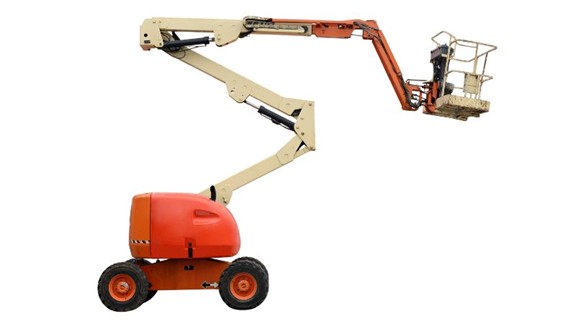
Boom lifts are defined by a hydraulic or telescopic arm that provides great mobility in the air. This arm can extend both vertically and, crucially, horizontally, allowing the platform to reach out and over obstacles—far beyond the machine’s chassis.
This key feature means the platform frequently operates outside the machine’s tipping line. Their superior outreach and flexibility make boom lifts the ideal mobile choice for tasks requiring access to complex, irregular, or hard-to-reach locations.
Mobile/Single-mast Scissor Lifts
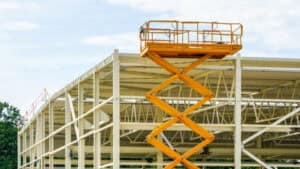
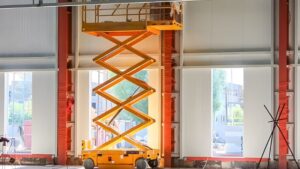
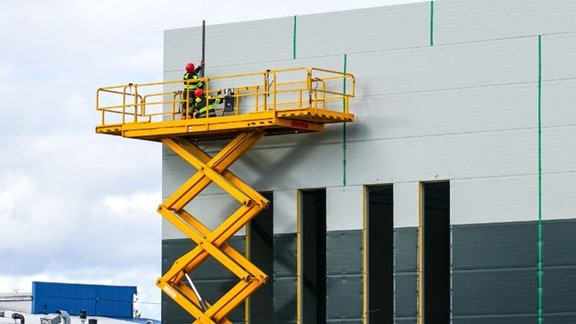
In contrast, scissor lifts prioritize vertical mobility. They operate via a criss-crossing “scissor” mechanism that raises a large, stable platform straight up and down, keeping it consistently within the machine’s tipping line for enhanced stability.
While their aerial movement is strictly vertical, their mobile base allows them to be positioned precisely underneath the work area. This combination makes them exceptionally well-suited for jobs that require a steady, spacious platform for prolonged work at height, such as interior installations, ceiling work, inspections, and electrical maintenance.
Major Applications
MEWPs provide versatile access solutions across multiple industries, enhancing both safety and efficiency for elevated tasks.
Building and Repair
MEWPs serve as essential equipment for numerous building and repair operations. They appear in steel frame erection, roofing installations, cladding applications, electrical system setups, building repairs, HVAC maintenance tasks, etc.
MEWPs offer safer and more flexible access than traditional methods like scaffolding or ladders, reducing setup time and improving worker safety.
Manufacturing and Storage
MEWPs are also of vital importance in manufacturing plants and storage facilities. They handle tasks including equipment repairs, ductwork installations, and racking configurations. They assist in stocktaking activities and maintaining infrastructure such as lighting and sprinkler systems that are placed onto ceilings or rooftops.
MEWPs enhance operational efficiency by providing quick, reliable access to overhead areas, minimizing downtime and maximizing productivity.
Safety Standards and Regulations
Safety standards and regulations for MEWPs are critical to ensuring worker protection, as they cover proper equipment design, operator training, risk assessments, and the use of personal protective equipment.
Safety Programs and MEWP Training
Safe use plans demand operator intelligence, care, proper safety training, and medical fitness. Training certification lasts three years and covers:
- Operating the equipment safely
- Assessing potential worksite risks
- Inspecting the machine before use
- Planning for emergency rescues
- Preventing unauthorized usage
Employers keep certification and training records for at least four years.
Safety Equipment
Safety equipment is essential when operating Mobile Elevating Work Platforms (MEWPs). Operators must wear safety harnesses secured to anchor points to prevent falls or loss of balance. Additionally, workers should use personal protective equipment (PPE), including hard hats, safety goggles, reinforced boots, gloves, and high-visibility clothing, to enhance both protection and visibility.
Modern MEWPs are equipped with safety features such as guardrails, slip-resistant platforms, emergency stop buttons, load sensors, and anti-entrapment systems to help prevent accidents. Using the correct safety gear, machine features, and following safe work practices greatly reduces the risks associated with working at heights.
Choosing the Right MEWP for Your Job
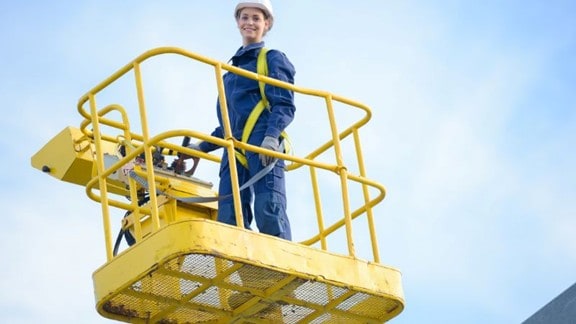
In order to make the right choice when selecting MEWP, you need to draw a clear boundary and set some ground rules: focus on mobility, while also taking rated capacity, working height, and required outreach into consideration. Evaluate site conditions including ground stability, access points, and proximity to workers or the public.
|
Selection Factor |
Considerations |
Example Applications |
|
Working Height |
Maximum elevation needed |
Replacing warehouse lighting |
|
Outreach |
Horizontal reach required |
Installing exterior cladding |
|
Ground Conditions |
Stability, slope, surface type |
Operating on rough terrain |
|
Power Source |
Electric, diesel, hybrid |
Indoor vs. outdoor use |
For example, you want to replace some warehouse lighting fixtures, but the factory floor is packed with machines and the ceiling is just too high for ladders. In this scenario, a single-mast scissor lift that reaches as high as 10 meters/ 32ft and only takes up a 1360 mm x 850 mm area without deployed outriggers would be the best choice.
In another case, you attempt to move something heavier to higher grounds, maybe a shipment of materials, a few workers, or some equipment, but the floor space is still not vacant enough for heavy-duty lifting machines. Then, you would need this 300 kg scissor lift. For a comparatively lower profile, it carries a heavy load and can reach an elevation of 14 meters/ 46ft, and guarantees a perfect balance between load capacity and working height.
Conclusion
Now you know what MEWP stands for and why it matters and have seen how these machines can make your elevated work safer and more efficient.
Remember that choosing the right equipment and following safety protocols are essential. The awareness of MEWP types and classifications helps you make informed decisions on the job.
Stay updated on regulations and always prioritize proper training. Your knowledge of MEWPs contributes to a safer work environment for everyone involved.
Frequently Asked Questions
Is a cherry picker an MEWP?
Yes, a “cherry picker” is a common nickname for certain boom lifts (or even for an order-picker forklift), and these are considered types of MEWPs. For example, an articulating boom lift with a bucket is often called a cherry picker, and it falls under the MEWP classifications.
What is the difference between AWP and MEWP?
The principal difference between AWPs and MEWPs is terminology and classification. Previously, the term “AWP” was used to refer to various elevated work platforms such as scissor lifts and boom lifts. However, the new term MEWP has been introduced to encompass a broader range of equipment.
How many years is an MEWP certification valid?
A MEWP (Mobile Elevating Work Platform) certification typically lasts three years from the date of training. After this period, operators are required to complete a refresher course to remain compliant with safety standards and regulations.