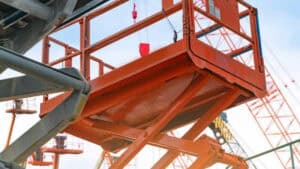
Understanding the key features, advantages, and limitations of scissor lifts and forklifts helps you select the option that best fits your needs.
Key Considerations:
- Purpose: Scissor lifts support work at heights; forklifts transport heavy loads
- Project Requirements: Determine how much weight you’ll lift and how high you need to elevate workers or materials
- Workspace Constraints: Scissor lifts need vertical clearance; forklifts require maneuvering space in aisles
- Safety Standards: Both require proper training—OSHA standards mandate certified forklift operators and proper training for aerial lift users
Overview of Forklift and Scissor lift
What is Scissor Lift?
A scissor lift is a type of aerial work platform that uses a crisscross mechanism to provide vertical elevation. As a specialized work platform, this design delivers stability when raising the platform straight up, making it ideal for tasks that require elevated work in a fixed location.
Key Features:
- Vertical Movement: Extends straight up for stable, safe work at height
- Load Capacity: Supports approximately 500–2,000 lb, roughly 2–8 adults with gear and materials
- Built-in Fall Protection: Guardrails and safety barriers keep operators secure
- Multiple Power Options: Diesel, electric, or hydraulic models for indoor or outdoor use
- Compact Footprint: Minimal base allows operation in confined spaces without requiring extensive work area clearance
What is Forklift?
A forklift is designed for lifting, carrying, and stacking heavy loads over short distances. Using two-pronged forks, these machines move efficiently through tight spaces in warehouses and construction sites.
Key Features:
- Lifting Capacity: From roughly 3,000 lb up to over 100,000 lb.
- Fuel Variety: Electric batteries, propane, diesel, or gasoline for different job-site demands
- Maneuverability: Rear-wheel steering and a compact chassis for narrow work areas
Main Differences Between Scissor Lifts and Forklifts
|
Feature
|
Scissor Lift
|
Forklift
|
|---|---|---|
|
Primary Function
|
Elevate workers to heights for maintenance and installation
|
Transport and lift heavy loads horizontally
|
|
Movement Type
|
Vertical only
|
Horizontal and vertical
|
|
Load Capacity
|
500–2,000 lb
|
3,000–100,000+ lb
|
|
Platform Type
|
Large, stable work platform for personnel
|
Fork attachment for pallets and materials
|
|
Ideal Environment
|
Indoor/outdoor with vertical space
|
Warehouses, loading docks, construction sites
|
|
Noise Level
|
Electric models are quiet
|
Fuel models generate noise; electric quieter
|
|
Setup Location
|
Stationary during operation
|
Mobile across the work area
|
How to Choose the Right Equipment for Your Job Site?
Scissor Lifts Advantages and Limitations
Advantages:
- Provide a stable, roomy work platform for raised access in tight work areas
- High load capacity supports multiple people, gear, and tools safely
- Electric models offer quiet, zero-emission operation suited to noise-sensitive environments
Limitations:
- Move only vertically—cannot transport materials horizontally across distances
- Require sufficient vertical clearance overhead to operate safely
Forklifts Advantages and Limitations
Advantages:
- Excel at lifting and moving heavy loads over short to medium distances
- Multiple configurations handle pallet stacking, material transport, and tight-aisle navigation
- Highly maneuverable in narrow aisles, busy warehouses, and active construction sites
Limitations:
- Do not provide a stable, elevated work platform for personnel safety
- Fuel-powered models can be noisy and emit exhaust fumes
When to Choose a Scissor Lift?
- Installation and finishing work on ceilings and high walls
- Routine maintenance tasks requiring elevated work at heights
- Tasks that require operators must work together on a stable platform
- Indoor environments where noise and emissions are concerns
- Projects where you need to elevate workers with their equipment safely
When to Choose a Forklift?
- Loading and unloading trucks at warehouses and distribution centers
- Moving pallets in storage areas and organizing inventory
- Material transport on construction sites and industrial facilities
- Tasks involving heavy loads that need horizontal movement
- Operations in tight aisles where compact maneuverability is essential
Frequently Asked Questions
Are electric forklifts better than fuel-powered models?
Electric forklifts offer quieter operation, zero emissions, and lower fuel costs, making them ideal for indoor warehouses and noise-sensitive environments. Fuel-powered forklifts provide greater lifting capacity and longer runtime for heavy-duty outdoor work. Your choice depends on your specific job-site conditions, budget, and environmental priorities.
How much space does a forklift need to operate efficiently?
Forklifts require adequate aisle width—typically 10–12 feet for standard models, though reach trucks can operate in narrower 8–10 foot aisles. Allow clearance for turning radius, loading dock access, and vertical stacking height. A site assessment by your equipment provider helps determine if your warehouse accommodates your chosen model.
What are the OSHA rules for scissor lifts?
OSHA requires trained operators to inspect machines daily, wear appropriate PPE, never exceed load capacity, and follow manufacturer guidelines. Only authorized personnel may operate aerial work platforms, and employers must maintain training documentation and conduct refresher training as needed.
Are there any specific training or certifications required to operate a scissor lift instead of a forklift?
Yes, each type of equipment needs specific training. For scissor lifts, you need to complete a training course on safety and operation.
Forklift operators must be certified and usually need more in-depth training because forklifts are more complex and carry more risks.