Suspended scaffolds hang from cables or ropes on tall buildings, which are one of the most dangerous types of scaffolding used in construction.
OSHA requires suspended scaffolds to have both guardrails and personal fall arrest systems, along with proper tie-backs, secure counterweights, and independent suspension systems to keep workers safe.
This guide covers the specific safety rules, fall protection systems, and inspection practices you need to follow when working with suspended scaffolding.
What Is a Suspended Scaffold?
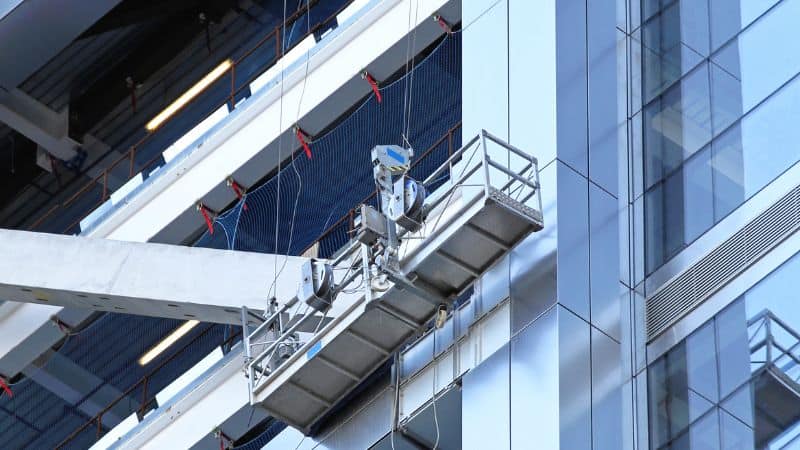
A suspended scaffold is a platform that hangs from an overhead structure with non-rigid supports like ropes or cables. You’ll encounter several types in construction work:
Common Types:
- Two-point adjustable suspension scaffold (swing stage) – the most common type with two support ropes
- Single-point adjustable suspension scaffold – hangs from one rope
- Multi-point adjustable suspension scaffold – uses more than two support ropes
- Catenary scaffold – supported by two horizontal parallel ropes
- Float scaffold – rests on parallel bearers with fixed-length supports
Key OSHA Safety Requirements for Suspended Scaffolding
Suspended scaffolds fall under OSHA 1926 Subpart L. These systems consist of work platforms suspended by ropes or cables from overhead structures, using stirrups or beam hangers for attachment, plus mechanical hoisting equipment for vertical movement.
Critical Safety Requirements
Load Capacity Scaffolds must withstand four times the maximum intended load—this means if you plan to load 500 pounds of workers, tools, and materials, the system must be rated for 2,000 pounds. Before starting work, verify the manufacturer’s load rating and calculate your actual working load. Post these limits visibly on the platform. Overloading causes catastrophic failures.
Platform Standards Platforms require full planking with no gaps between front uprights and guardrails. Use scaffold-grade planks or manufactured deck units—never substitute standard lumber. When loaded, deflection cannot exceed 1/60 of the span (a 10-foot span can deflect no more than 2 inches). Support planks every 8-10 feet depending on thickness and material grade.
Fall Protection Install guardrail systems on all open sides and ends:
- Top rail: 38-45 inches high (typically 42 inches)
- Midrail: midway between top rail and platform surface
- Toeboards: minimum 3.5 inches high with no more than 1/4 inch gap to platform
- Maximum opening between rails: 19 inches
For two-point adjustable scaffolds, workers must also use personal fall arrest systems tied to independent lifelines.
Erection and Access Only competent persons trained in scaffold erection may assemble these systems. Follow manufacturer specifications exactly—field modifications void safety certifications. Provide safe access via built-in ladders, stair towers, or secured portable ladders. Cross-bracing is not an access method. Inspect all suspension ropes, hoisting mechanisms, and anchorage points before each shift.
Fall Protection and Worker Safety Systems
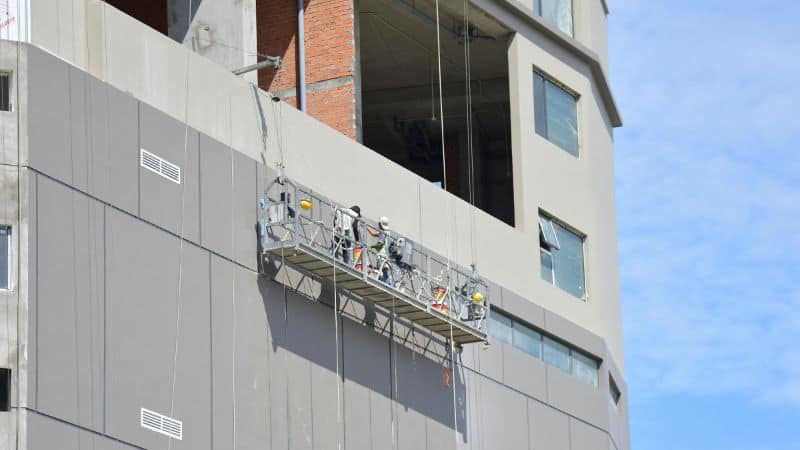
Suspended scaffold work demands layered protection because workers face both fall hazards and struck-by risks. OSHA mandates personal fall arrest systems at heights exceeding 10 feet, independent anchorage for lifelines, and overhead protection in multi-level operations.
Personal Fall Arrest Systems
Workers must wear full-body harnesses—never waist belts—connected to independent lifelines separate from the scaffold suspension system. The lifeline must be anchored to structural elements capable of supporting 5,000 pounds per attached worker, or designed with a safety factor of two under the supervision of a qualified person.
Use self-retracting lifelines or shock-absorbing lanyards to limit free fall to 6 feet maximum. Critical point: your lifeline attachment cannot be to the scaffold itself. If the scaffold fails, your fall protection must remain intact. Secure lifelines to permanent building anchors, certified tie-off points, or engineered horizontal lifeline systems.
Tiebacks and Anchorage Systems
Tiebacks prevent scaffold rotation and must equal suspension rope strength. Install them perpendicular to the facade at a maximum 4:1 horizontal-to-vertical ratio. On structures without penetrable walls, use through-bolts or certified adhesive anchors—never wrap around pipes, conduit, or HVAC equipment.
Counterweights
When direct anchorage is impossible, counterweights stabilize outrigger beams. Use manufactured counterweight blocks or engineered materials secured with mechanical restraints—cable ties, chains, or locking pins that prevent sliding during platform movement. Sand bags, loose blocks, or water barrels are prohibited. Calculate counterweight requirements based on beam length, platform load, and offset distance. Typical ratios require 4-7 times the suspended load as counterweight.
Falling Object Protection
Install 3.5-inch toeboards plus debris netting along platform edges when working above pedestrian areas or other work zones. For overhead hazards—work occurring on floors above your scaffold—require hard hats and install canopy structures capable of withstanding 100 pounds dropped from 10 feet. Barricade ground-level areas directly below scaffold operations.
Inspection, Training, and Compliance
Scaffold safety depends on qualified oversight, systematic inspections, and workers who understand both equipment limits and their own responsibilities.
Competent Person Requirements
The competent person must have documented training in scaffold hazards, load calculations, and OSHA Subpart L standards. Responsibilities include:
- Pre-shift inspections of all scaffold components
- Authority to halt work when hazards exist
- Verification that repairs meet manufacturer specifications
- Post-incident inspections after weather events, impacts, or modifications
This person inspects ropes for broken wires (removal required at 6 randomly distributed broken wires in one lay, or 3 in one strand), checks hoist mechanisms for proper operation, and confirms platform levelness within 1 degree.
Qualified Person Role
The qualified person possesses engineering knowledge to design rigging systems, calculate load distributions, and approve non-standard configurations. They certify that anchorage points meet strength requirements, review suspension rope angles, and sign off on custom outrigger designs. On complex projects, this is typically a professional engineer or manufacturer’s representative.
Inspection Protocols
Conduct inspections:
- Before each shift
- After windstorms exceeding 25 mph
- Following any impact or near-miss incident
- When adding or removing materials that affect loading
Document inspection findings with date, inspector name, deficiencies identified, and corrective actions taken. Remove defective components immediately—damaged suspension ropes, worn sheaves, cracked welds, or bent outrigger beams must be replaced, not repaired in the field.
Training Requirements
Initial training must cover:
- Scaffold load limits and how to calculate working loads
- Fall hazard recognition and proper harness use
- Emergency descent procedures if hoists fail
- Electrical hazard awareness near power lines (maintain 10-foot clearance from lines under 50kV)
- Hand signals for coordinating multi-point scaffold movements
Require retraining when workers change to different scaffold types (switching from two-point adjustable to multi-point suspension), after observed unsafe behavior, or following incidents. Training isn’t a one-time event—competency verification should occur before workers operate hoists independently.
Workers must understand they’re responsible for inspecting their personal fall protection before each use, reporting equipment damage immediately, and never modifying scaffold configurations without competent person approval.
Contact IHURMO for Professional Scaffolding Solutions
IHURMO is a specialized manufacturer dedicated to providing high-altitude machinery that aligns with global safety benchmarks. With a history of successful applications in Iraq, Lithuania, Russia, Ukraine, and the Middle East, we provide reliable logistics and professional support to international clients.
Frequently Asked Questions
What are the safety training requirements for workers on suspended scaffolds?
You must complete training before working on suspended scaffolds. Your training needs to cover how to use the equipment, recognize hazards, and follow safety procedures. OSHA requires that a qualified person provides this training.
Your employer must retrain you if conditions change or if you show gaps in your knowledge.
How often should suspended scaffolding be inspected for safety compliance?
You need to inspect suspended scaffolds before each work shift. A competent person must perform these daily inspections.
You should also inspect the scaffold after any event that could affect its structural integrity, like storms or accidents.
What are the load capacity guidelines for safely operating a suspended scaffold?
Your scaffold must support at least four times the maximum intended load. You need to know the weight rating before adding workers, tools, and materials.
Never exceed the manufacturer’s rated load capacity.
Can you tell me the specific fall protection measures required for suspended scaffolding?
You must use guardrails or personal fall arrest systems when working on suspended scaffolds. Your fall protection equipment needs proper anchorage points.
You should wear a harness connected to an independent lifeline that’s separate from the scaffold support system.
What are the requirements for the proper use and maintenance of suspension ropes and cables?
Your suspension ropes must have a safety factor of at least six times the maximum intended load. You need to inspect ropes before each use for wear, damage, or deterioration.
Replace ropes immediately if you find broken wires, corrosion, or other defects.
Are there specific regulations regarding the securement of tools and materials on suspended scaffolds?
You must secure all tools and materials to prevent them from falling. Use tool lanyards, bins, or containers to keep items in place.
Your work area below needs barricades or toe boards to protect people from falling objects.